

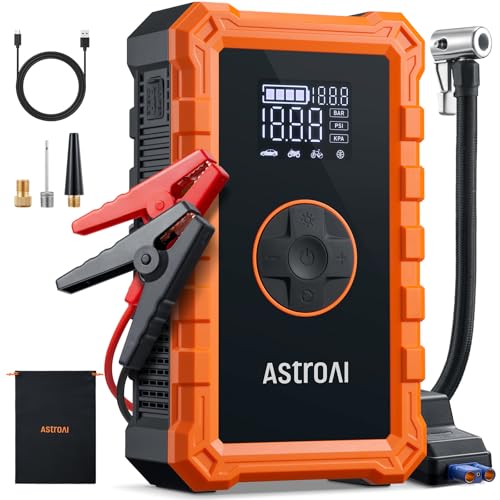
The core capabilities are closer than you might expect
These are the standard GOOLOO A3 and the 3,000A US-market S8 Air, not the A3 Lite, A3 Pro or plain AstroAI S8. Both combine a jump starter, target-pressure inflator, LED light and USB-A power in a single rechargeable kit.
Swipe across to compare both models.
| Specification | GOOLOO A3 | AstroAI S8 Air |
|---|---|---|
| Vehicle system | Compatible 12V | Compatible 12V |
| Engine range | Up to 9L gas / 6.5L diesel | Up to 9L gas / 6.5L diesel |
| Peak current | 3,000A | 3,000A |
| Battery energy | 44.4Wh | 37Wh |
| Maximum inflation pressure | 150 PSI | 150 PSI |
| Pressure control | Preset target; automatic stop | Preset target; automatic stop |
| USB-C charging input | 5V/2A (10W) | 5V/2A (10W) |
| USB-A device output | 5V/2.4A (12W) | 5V/2.4A (12W) |
| Wall charger in kit | No | No |
Both fit compatible 12V vehicles up to 9L gasoline or 6.5L diesel. Those limits do not establish equal starting reliability, and neither is a 24V truck starter. For a vehicle within range, choose around the workload and charging habits you will actually have.
What the A3’s extra battery buys you
The A3 stores 44.4Wh against the S8 Air’s 37Wh. Subtracting gives 7.4Wh extra, or 20% more rated energy: 44.4 ÷ 37 − 1 = 0.20. Watt-hours make this comparison meaningful without mixing battery-capacity labels measured at different voltages.
That reserve is most relevant if you also use the kit to charge a phone or run its light. The same battery serves all functions, so energy spent on those jobs is no longer available for a jump-start or inflation. At a similar purchase price, the A3’s extra capacity is a useful reason to choose it.
It does not mean 20% more successful starts, 20% more tires or stronger cranking. Those results depend on the load, battery condition, temperature and each unit’s efficiency. If you recharge after every use and only carry the kit for rare emergencies, the capacity difference may matter less than the price you actually pay.
For tires, think about the whole job
Both let you select a pressure and stop inflation at the target. For routine car-tire top-offs, that is more useful than choosing between identical 150 PSI maximums. Set the vehicle’s recommended cold-tire pressure rather than assuming its preset matches your car.
The S8 Air needs at least 10 minutes of rest after 10 minutes of continuous pumping. If a job requires two full 10-minute runs, the intervening rest makes it at least a 30-minute job before setup. That is a workload illustration, not a prediction of how long either product takes to fill your tire.
The A3’s 35 L/min airflow rating is not a measured advantage over the S8 Air on your tires. It is not a reason to assume the A3 can run continuously either. For four large tires after off-roading, choose a dedicated compressor with the duty cycle and power supply that job requires. Neither combo earns our recommendation for that use simply by having a high pressure ceiling.
For a slightly low daily-driver tire, either format can save you carrying a separate inflator. For a puncture, both only add air; neither repairs the cause of the pressure loss.
Neither solves slow charging
Both USB-C ports accept 5V/2A input, a 10W ceiling. Both provide up to 12W through USB-A for compatible devices. Neither gives you USB-C Power Delivery output for a laptop, and a higher-wattage wall charger does not increase the pack’s input limit.
Both kits include a USB-A-to-USB-C cable but no wall charger. You will also need a USB-A-compatible cable for your phone if you intend to use the power-bank function. If your travel kit uses only USB-C-to-USB-C cables, this is a practical reason to consider another model.
The A3 includes clamps, a hose, five air nozzles and a carrying bag. The S8 Air includes clamps, a hose, a Presta adapter, ball needle, air nozzle and storage bag. Both require you to keep detachable accessories together; neither is just a single object you can toss into the car without its attachments.
Leave it ready, not depleted
Recharge either pack after use and every three months in storage. Protect it from prolonged heat rather than leaving it in a sun-heated cabin indefinitely. For the S8 Air, keep more than 75% charge for best starting results; the A3 should have more than two battery bars before a start.
Do not swap one model’s starting instructions for the other. The S8 Air specifies at least 60 seconds between attempts. The A3 specifies two minutes, no more than three consecutive attempts, and 30 minutes of cooling before recharging after jump-starting. Use the supplied clamps and the vehicle’s designated connection points.
Which would we buy?
Choose the A3 when prices are close and extra reserve matters
If you expect to use USB power as well as roadside functions, the larger battery gives you more stored energy without changing the basic charging setup. Read our GOOLOO A3 model guide for charging time, dimensions and ownership details.
Choose the S8 Air when it costs less and occasional backup is enough
You do not give up the stated engine-size range or target-pressure shutoff. For a compatible daily driver, a lower checkout price can outweigh reserve you rarely use. Our AstroAI S8 Air guide covers its controls, kit and cooling requirements.
Choose neither for fast USB-C power or frequent large-tire work
For USB-C device charging, consider the WOLFBOX MegaVolt24 Air. For repeated high-volume inflation, separate the starter and compressor purchases. Read the combo versus separate tools guide to compare the two setups. Our best jump starters with air compressors covers other combined options; the category buying guide explains when a combo makes sense.
Check the exact models
GearMyRide may earn a commission from qualifying Amazon purchases.