
Jump starter with air compressor: combo or separate tools?
A combo keeps two roadside jobs in one device. Separate tools let you choose the pump independently—and may still leave you with only one battery to charge.
Choose a combo for occasional pressure top-ups and emergency starting when both functions suit your vehicle. Keeping the pump, clamps and power supply together makes it easier to take the whole kit along.
Choose separate tools if you already own a good jump starter, use the pump often, or need a different compressor for your tires. You can upgrade the part you actually use without replacing the other. If your current tools already do both jobs well, there is little reason to replace them just to have one enclosure.
Separate tools can mean two different setups
The important distinction is where the pump gets its power. A separate 12V inflator does not add another rechargeable battery to maintain. A cordless one does, but can work without a vehicle power connection.
Swipe the table to compare all columns.
| Setup | Power arrangement | Choose it for | The tradeoff |
|---|---|---|---|
| Battery-powered combo | One pack powers starting and inflation. | Occasional roadside use when you want both tools together. | Pumping and USB use draw from the same reserve you keep for starting. |
| Jump starter + vehicle-powered inflator | Recharge the jump starter; the pump uses vehicle power. | Keeping the starting pack separate without charging a second tool. | The pump needs a suitable working vehicle power connection. |
| Jump starter + battery-powered inflator | Each tool has its own battery. | Using the pump away from the car or sharing it between vehicles. | Two batteries to check and recharge; keep both tools in the kit. |
If the car will not start, can you still inflate a tire?
A charged cordless pump or combo can inflate without drawing power from the car. A vehicle-powered pump depends on a usable supply. That matters if the car has a flat tire and an electrical problem at the same time.
The NOCO AIR10, for example, needs a compatible 12V outlet with a 15A fuse. Its instructions call for the vehicle to be on/running. It is not an independent air supply when that connection is unavailable. Never fit a larger fuse to make an unsuitable outlet work.
Separate batteries also keep routine inflation from using the jump starter’s reserve. With a combo, recharge after use rather than assuming the remaining charge will cover an emergency start. The jump starter with air compressor guide explains the functions and compatibility checks in more detail.
How much weight does a combo save?
Here is a concrete example: a NOCO Boost Air AX65 combo versus a NOCO GB40 jump starter carried with an AIR10 inflator. These have different capabilities, but their product weights show why counting devices alone is not enough.
Swipe the table to compare all columns.
| What you carry | AX65 combo | GB40 + AIR10 |
|---|---|---|
| Product weight | 6.95 lb | 2.45 + 5.39 = 7.84 lb |
| Starting coverage* | Up to 8L gas / 6L diesel | Up to 6L gas / 3L diesel |
| Inflation power | Internal rechargeable battery | Vehicle’s compatible 12V outlet |
| Maximum pressure | 100 PSI | 60 PSI |
*Compatible 12V lead-acid vehicle batteries. Product weights are specification values, not weighed travel kits; bags and extra accessories are not totaled.
The combo is 0.89 lb lighter in this particular comparison. It also has a higher rated engine range. That does not make every combo lighter or establish equivalent starting or inflation performance. For this pair, the separate setup’s reason to exist is its independent pump and vehicle-powered inflation—not a weight saving.
If the AX65 fits your vehicle, our NOCO Boost Air AX65 guide covers its charging, hose arrangement and limitations. You do not need to buy both separate tools from the same brand; match each to its job.
Choose the compressor around the tire job
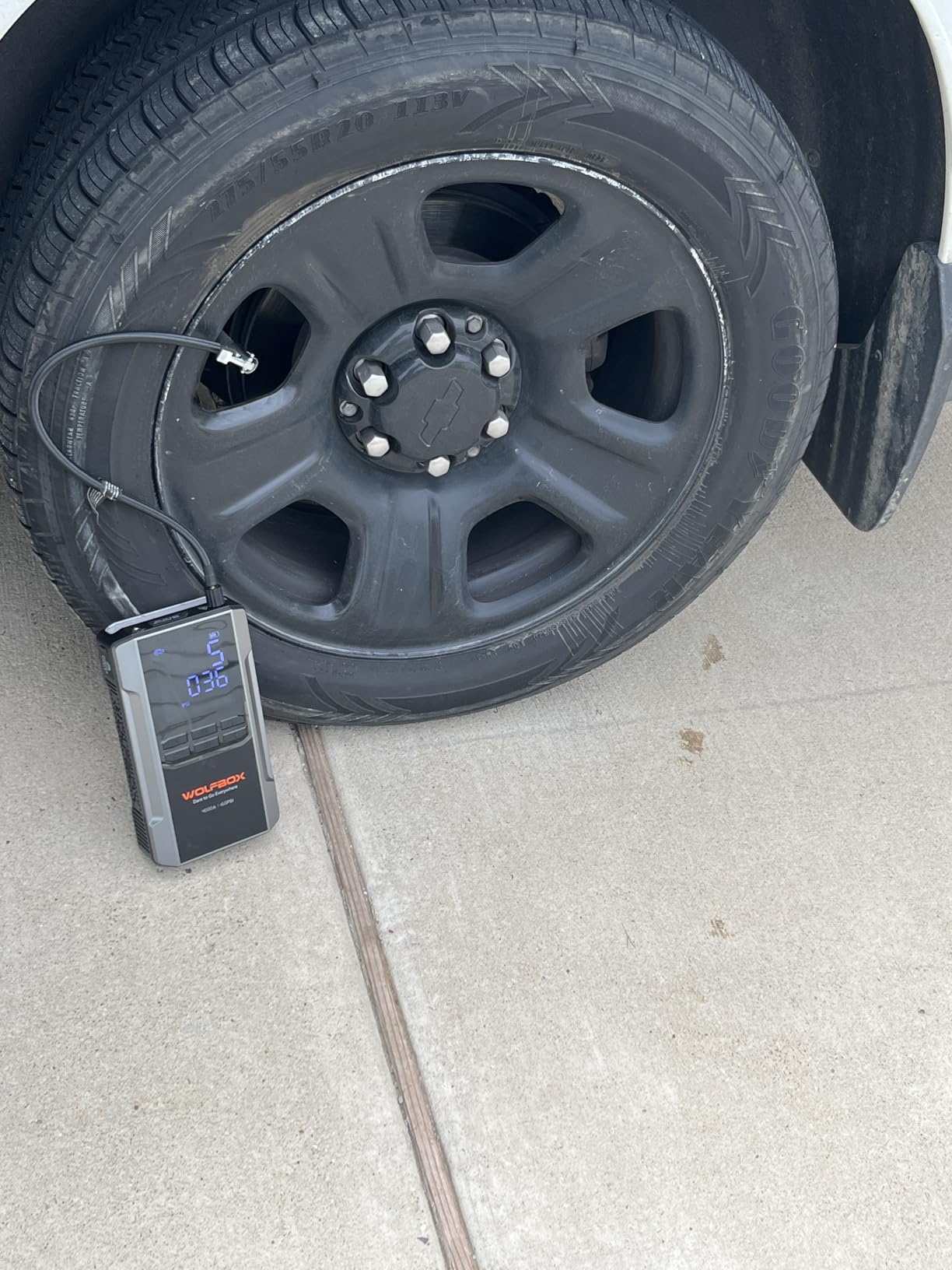
For occasional pressure corrections, a suitable combo can keep the job simple: take out one unit, connect the hose and put it back with the rest of the kit.
Repeatedly inflating several tires, especially after airing down for a trail, is a different workload. Start with the compressor’s tire-size range, required pressure, operating time and cooling interval. A dedicated compressor gives you more freedom to choose for that job, but “separate” by itself does not mean faster or continuous-duty.
Even a vehicle-powered pump has heat limits. The AIR10’s normal duty-cycle rating is 25 minutes on at 30 PSI followed by 35 minutes off; its manual mode has a different limit of 5 minutes on and 30 minutes off. A long power cord removes a battery-charging task, not the need for cooling breaks.
For frequent multi-tire work, choose a compressor with a documented duty cycle that suits the job, then select a jump starter separately. For occasional top-ups, prioritize manageable hose reach, pressure controls and easy storage. Our tire inflator guide explains what those specifications mean.
What changes when you live with the kit
Storage: fewer pieces, or more places to put them?
A combo keeps the two functions together, but its clamps, hose, adapters and charging cable still need a home. Compare the packed bag with your actual storage space. Bare-unit dimensions cannot tell you whether the complete kit will fit under a seat.
Separate tools can fit into two smaller spaces. That helps in a crowded car, provided the pump does not get left in the garage when you need it on the road. Keep both accessible without unloading the whole trunk.
Replacement: one failed tool need not replace both
With separate units, you can replace a worn-out pump while keeping the jump starter, or upgrade the starting pack for a different vehicle. If a combo needs to go away for service, both tools leave the car together.
That is flexibility, not proof that separate equipment is more reliable. Nor does one pump plus one jump starter give you a spare of either function. The condition of the batteries, connections and equipment still matters.
Cost: buy the function you are missing
If you already own a suitable starter, price an inflator before replacing the entire setup. If you own neither, compare complete packages: device, required charger or battery, cables, adapters and storage. A bare cordless inflator may need a battery and charger; a USB cable in a combo’s box does not necessarily include a wall charger.
For a household sharing one pump, separate equipment lets that pump move between cars while a jump starter stays in each vehicle. If you want one kit that always travels together, the combo is easier to organize. Either arrangement needs charge checks and storage within its equipment’s temperature limits.
Choose the setup, then the model
If you are starting from scratch and mostly want occasional roadside backup, compare our best jump starters with air compressors. Choose a model that covers both the engine and tire job; LED lights and USB ports are secondary to those needs.
If you already have one good tool, or inflation is a regular task, keep the two jobs separate. Start with the portable jump starter picks for the starting side and select the pump around its power source and workload.